

Losar: The Tibetan New Year and the Art of Conscious Renewal
- Posted on
- By tibet-markets.ch
- Posted in Buddhist Festivals, Mindful Living, Tibetan culture
- 0
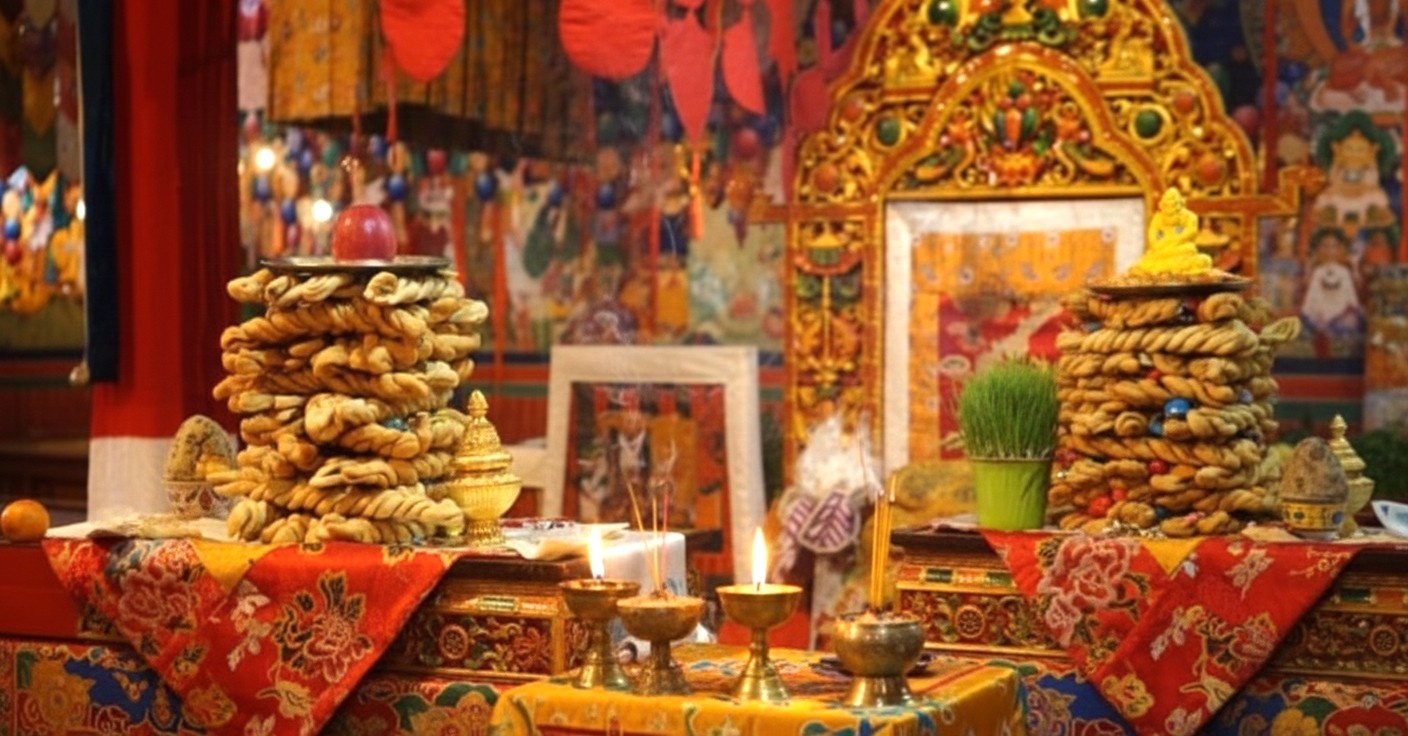
There is something quietly profound about the way the Tibetan New Year arrives. It does not announce itself with fireworks or countdown clocks. It comes instead through weeks of careful preparation, through the scent of juniper smoke rising from an altar, through the sound of prayers spoken softly in the early morning. Losar, as the Tibetan New Year is known, is one of the most significant festivals in Tibetan culture and Buddhism. And for those of us living fast, full lives in the modern world, its wisdom feels surprisingly close to home
A Festival Rooted in Deep Time
The origins of Losar stretch back well before Buddhism arrived on the Tibetan plateau. In the pre-Buddhist Bon tradition, communities marked the turning of the year with rituals designed to honour local spirits, ensure fertile harvests and maintain the delicate balance between the human world and the natural one. These early celebrations were earthy, seasonal and communal, grounded in a deep attunement to the rhythms of the land.
When Buddhism began to take root in Tibet from the seventh century onwards, it did not simply erase what came before. Instead, it wove itself into the existing fabric of seasonal and spiritual life, absorbing and transforming older practices into something new. The result was Losar as we know it today: a festival that carries the memory of ancient earth-based traditions within the philosophical and contemplative framework of Tibetan Buddhism.
The word Losar itself is straightforward in its meaning. Lo means year, sar means new. But behind this simplicity lies a rich cosmological understanding of time. The Tibetan calendar is a lunisolar system, shaped by both Indian astronomical traditions and local Tibetan calculations. Each year is associated with one of five elements (wood, fire, earth, metal or water) and one of twelve animals, a cycle drawn from broader Asian astrological traditions. These associations are not decorative. They reflect a Buddhist worldview in which all phenomena, including time itself, are interconnected and carry karmic weight.
The Inner Work of Preparation
Losar does not begin on New Year's Day. The weeks leading up to the festival are considered just as important as the celebration itself, perhaps even more so. This preparation period is a time of thorough cleansing on every level: physical, energetic and spiritual.
Homes are cleaned from top to bottom. Old or broken objects are let go. Walls may be freshened, altars carefully tended, and spaces rearranged to welcome a new cycle of energy. This outer clearing mirrors an inner one. Grievances are examined. Relationships that have grown strained are tended to. Old resentments are released, not because forgiveness is always easy, but because carrying them into a new year simply weighs too much.
Alongside this, rituals of energetic purification are performed. Tibetan incense, often crafted from blends of juniper, sandalwood and healing herbs, is burned to clear spaces of stagnant or negative energy. The rising smoke is understood as a vehicle for prayers and intentions, a bridge between the everyday world and the sacred. For many practitioners, the simple act of lighting incense with full attention becomes a form of meditation in itself.
This preparatory phase is an invitation to ask an honest question: what do I want to carry forward, and what would be wiser to leave behind? It is a practice not unlike the reflective pause many of us take at the close of any significant chapter.
The Fifteen Days of Losar
Losar is not a single day but a festival that traditionally unfolds over fifteen days, with the first three carrying the greatest ceremonial intensity. Each of these days holds its own significance and its own particular focus.
The first day, known as Lama Losar, is dedicated to spiritual teachers and deities. Monasteries and temples come alive with puja ceremonies, the deep resonance of monastic chanting and the sound of ritual instruments. At home, altars are prepared with special care. Fresh offerings of fruit and ceremonial foods are placed, and the chemar bo takes its honoured position at the centre of the altar space.
The chemar bo is a beautifully crafted ritual vessel, divided into two chambers. One is filled with roasted barley flour, known as tsampa, a Tibetan staple. The other holds a mixture of butter and sugar. Ears of grain and sculpted butter ornaments are often placed on top. As an object, the chemar bo is a tangible prayer for abundance, fertility and a fruitful year ahead. It speaks of gratitude for what sustains life and hope for what the coming year may bring.
Prayer flags are renewed at this time too, hung at windows, on rooftops or outdoors in open air. Their five colours, blue, white, red, green and yellow, represent the five elements. The mantras and prayers printed on them are carried by the wind, understood to spread blessings to all living beings. There is something deeply generous about this practice: your prayers are not kept for yourself alone. They are released into the world.
The second day, Gyalpo Losar, shifts attention toward community. Families and friends gather, meals are shared and good wishes exchanged. This is also when khatas are offered. A khata is a ceremonial scarf, usually white or cream, given as a gesture of respect, warmth and blessing. It might be draped over a statue, offered to a teacher or placed around the shoulders of a loved one. Its simplicity carries great meaning: a clean cloth, open hands, a sincere heart.
The third day, Choe-kyong Losar, honours protective forces and local spirits. New prayer flags are raised, incense is burned on hilltops and at sacred sites, and spiritual intentions are renewed. This is a day of gratitude and protection, of asking for the removal of obstacles and the strengthening of what is good.
Food, Music and the Body of Celebration
Losar is also a festival of the senses. Food plays a central role, particularly guthuk, a hearty noodle soup traditionally prepared on New Year's Eve. Hidden within the soup are small dough balls or objects, each carrying a symbolic meaning: a piece of coal suggests a dark heart, wool indicates generosity, salt points to laziness. Finding one is met with laughter and reflection, a gentle, playful mirror held up to the self.
Khabse, intricately shaped fried pastries, and dresil, a sweet rice dish with butter and dried fruit, are prepared as offerings and shared with guests. These are not simply festive foods. They are acts of generosity, of nourishment given freely to others.
In monasteries, cham dances are performed by monks wearing elaborate costumes and carved masks representing deities and spirits. These ritual dances are a form of sacred theatre, intended to dispel negative forces and invoke protection and blessings for the year ahead. Even for those watching without detailed knowledge of the symbolism, there is something unmistakably powerful about witnessing a community enact its deepest stories and beliefs in movement and colour.
The Spiritual Core: Impermanence and Renewal
At its heart, Losar is a Buddhist festival, and its deepest teaching is one that runs through all of Buddhist philosophy: impermanence. The year that has passed is gone. The year ahead is not yet here. This present moment, with all its possibility and uncertainty, is where life actually happens.
In the Tibetan view, time is not a straight line moving from past to future but a wheel, cycling through patterns of cause and effect, of karma and consequence. The new year is not a blank page on which everything can be magically rewritten, but it is a genuine opportunity to recognise the patterns we carry, to choose which ones to strengthen and which to gently release.
Many practitioners use the Losar period for intensive meditation, mantra recitation or the study of sacred texts. Statues of Buddhas and Bodhisattvas are honoured with special care: cleaned, adorned with offerings and meditated upon as embodiments of the qualities we aspire to cultivate within ourselves. Sitting before a well-loved statue of the Buddha, making a simple offering and setting a sincere intention is one of the most quietly powerful things a person can do at the threshold of a new cycle.
Losar and the Mindful Life: What This Festival Offers Us
For those of us engaged with mindfulness, meditation or a broadly spiritual way of living, Losar speaks a language we already recognise. It asks us to slow down. To clean up. To pay attention. To be honest about what we are carrying and what we might put down. To gather with the people who matter to us and to mark the passing of time not just with celebration but with consciousness.
The rituals of Losar are not complicated. Lighting incense with awareness. Hanging prayer flags with the intention that your good wishes reach beyond yourself. Offering a khata to someone you love or respect. Placing fresh offerings on an altar. Cooking food slowly and sharing it generously. Each of these is a small act that, performed with full attention, becomes something more than habit. It becomes practice.
Losar also reminds us that renewal is not passive. It requires effort. The cleaning, the reflecting, the reconciling, the setting of intentions: these are all active choices. The new year does not simply arrive and wash us clean. We participate in our own renewal.
For those who feel drawn to honour Losar in their own way, even small gestures can carry real meaning. Clear a space in your home with care. Burn quality incense as an act of offering and presence. Hang prayer flags somewhere they will catch the wind. Set a clear intention for the months ahead, not a resolution born of pressure, but a genuine aspiration chosen freely and held lightly.
Respect, Appreciation and Authentic Engagement
There is, of course, an important note to strike here. Tibetan culture is not a collection of aesthetic objects or mood-setting accessories. It is a living tradition, shaped by centuries of wisdom, suffering, devotion and resilience. When we engage with elements of this culture, whether through the objects we bring into our homes or the practices we incorporate into our lives, it matters that we do so with genuine respect and a desire to understand, not merely to consume.
Learning about the meaning behind prayer flags before hanging them, understanding what a khata represents before offering one, knowing the ritual context of a chemar bo before placing it on an altar: these are simple acts of respect that deepen our relationship with these objects and with the culture from which they come.
Tashi Delek. May the new year bring clarity, warmth and genuine wellbeing to all beings.
Comments
Be the first to comment...