

Saga Dawa: The Holiest Month in Tibetan Buddhism
- Posted on
- By tibet-markets.ch
- Posted in Saga Dawa, Tibetan Buddhism
- 0
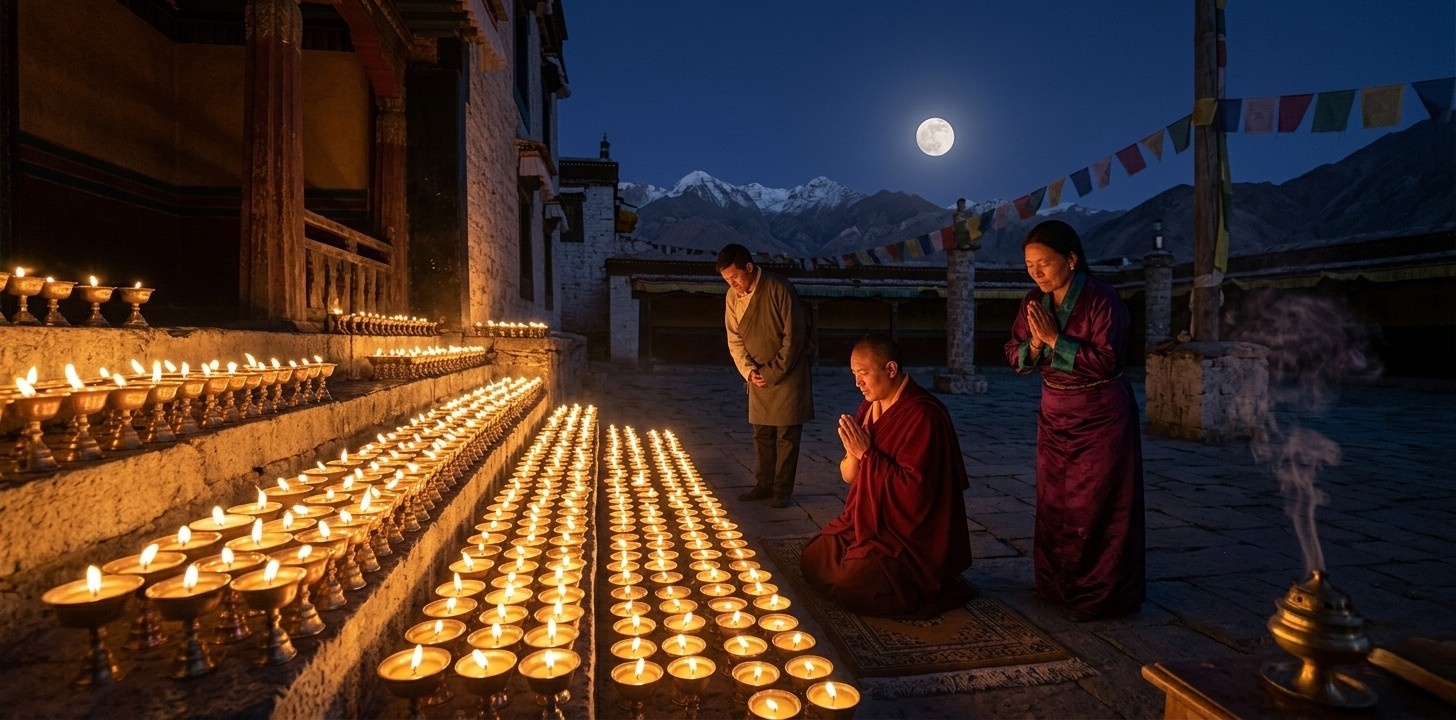
A time of reflection, generosity and inner renewal.
What is Saga Dawa?
Within the rhythm of the Tibetan lunar calendar, one month stands apart from all others: Saga Dawa, the fourth month of the Tibetan year. Its name comes from a particular star that appears in the night sky during this period. But beyond its astronomical significance, this month carries a spiritual weight unmatched anywhere in the Buddhist world.
Saga Dawa is not a single holiday. It is an entire sacred month, one in which three of the most profound events in the life of the historical Buddha Shakyamuni are said to converge: his birth, his enlightenment, and his Parinirvana, meaning his final passing beyond death into complete liberation. All three are believed to have fallen on the same day of the lunar calendar: the full moon of the fourth month, known as Saga Dawa Düchen. The word Düchen means, roughly, "great occasion" in Tibetan.
For practitioners of Tibetan Buddhism, this day is one of the four major Düchen of the year, days on which the karmic weight of every action, positive or negative, is said to be dramatically multiplied. On Saga Dawa Düchen itself, that multiplying effect is held to reach one hundred million times the ordinary force of any given act. This gives the month a quality of spiritual seriousness that shapes everything within it.
Three Moments, One Sacred Month: Birth, Enlightenment, Parinirvana
To really understand Saga Dawa, it helps to sit with the three events at its heart.
The birth of the Buddha marks the arrival of Prince Siddhartha Gautama into this world, the man who would later become Buddha Shakyamuni. Born into a royal family in what is today the borderland between Nepal and India, his birth was said to be extraordinary from the very first moment. Flowers bloomed, the natural world shifted, and tradition holds that the universe itself responded to his arrival. For practitioners, this is not merely a historical fact but a cosmic signal: that liberation is possible, that the door is open for all beings.
The enlightenment of the Buddha is, in many ways, the pivotal moment in the history of human consciousness. After years as an ascetic, Siddhartha Gautama recognised that extreme renunciation was bringing him no closer to truth. He sat beneath a fig tree, later to be known as the Bodhi tree, and resolved not to rise until he had reached complete understanding. That night, he saw through the nature of reality, perceived the roots of suffering, and found the path beyond it. He became the Buddha, the Awakened One.
The Parinirvana of the Buddha refers to the death of the enlightened teacher at the age of around eighty. Unlike ordinary death, Parinirvana is understood not as an ending but as a final passing beyond all karmic bonds, a complete dissolution into the liberated state. It is not an occasion for grief but for deep reverence and contemplation.
That all three of these events are held to fall within the same lunar month is, for Tibetan Buddhists, no coincidence. It is understood as an expression of deep cosmic order.
Saga Dawa and the Wider Buddhist World: A Shared Heritage
The events that Saga Dawa commemorates are not exclusive to the Tibetan tradition. They lie at the foundation of Buddhism as a whole. In the Theravada traditions of South and Southeast Asia, the full moon of the month of Vaisakha is observed as one of the holiest days of the year, known as Vesak or Wesak. Vesak is even recognised by the United Nations as an international day of observance, celebrated by Buddhist communities across the globe. In Japan, the birth of the Buddha is marked separately as Hanamatsuri, the flower festival, with its own date and its own distinct rituals.
What sets Saga Dawa apart within this wider Buddhist family is the particular depth and breadth of its observance. Where Vesak is often a single festive day, Saga Dawa encompasses an entire sacred month of practice, ritual, fasting, and inner work. The Tibetan tradition has built around this month a rich layering of ceremony, contemplative discipline, and spiritual instruction that gives it a character all its own. Saga Dawa is thus both part of a universal Buddhist remembrance and a profoundly Tibetan festival with its own irreducible spirit.
Saga Dawa in the Year: A Month of Sacred Time
Saga Dawa falls according to the Tibetan lunar calendar, landing roughly in May or June in the Gregorian year, depending on the year. It arrives as the natural world is waking up, days growing longer, light intensifying. There is something fitting about this: a month devoted to awakening arrives precisely when the season is doing the same.
The whole month is considered sacred, not just the full moon day. Many practitioners take on special commitments for the entire period: refraining from meat, increasing acts of generosity, deepening their meditation practice, and attending prayer ceremonies more regularly. Living with the awareness that each action carries heightened karmic significance changes the texture of even ordinary days.
It is also a month when people who might otherwise have little involvement with formal religion find their way to temples, light butter lamps, make offerings, and sit together in prayer. The sense of community, what Buddhism calls the Sangha, becomes especially vivid during this time.
Traditions and Rituals: What Happens During Saga Dawa
The practices associated with Saga Dawa are varied and deeply embedded in lived devotion. They differ between regions and between Buddhist schools, but certain elements are nearly universal.
Mantras and prayers are at the centre of daily practice. Om Mani Padme Hum, the most widely known mantra in Tibetan Buddhism, is recited with particular frequency throughout the month. It is associated with Avalokiteshvara, the bodhisattva of compassion, and its recitation is understood to awaken compassion and purify karma. In monasteries, extended puja ceremonies, ritual acts of veneration, take place each day.
Nyungne is a specific fasting practice carried out especially in the middle of Saga Dawa. It is an intensive two-day retreat combining fasting, silence, prostrations, and the recitation of prayers and mantras. Nyungne is regarded as a particularly powerful method for purifying negative karma and is offered in many monasteries during this month.
Prayers for all beings take on special urgency in this period. Tibetan Buddhists hold that prayer, particularly during times of heightened karmic potency, benefits not only the individual practitioner but ripples outward to all sentient beings. The motivation behind every act during Saga Dawa, whether prayer, meditation, or generosity, is ideally directed toward the welfare of all.
Raising prayer flags is a central ritual of the month. New flags are blessed and hung at elevated points where the wind can move them freely. According to traditional understanding, the wind carries the prayers and blessings printed on the flags outward in all directions. Old flags are burned respectfully rather than simply discarded. Hanging new flags during Saga Dawa is an act of renewal, both outward and inward.
Smoke offerings and incense accompany many of the ceremonies of this month. The burning of incense is, in the Tibetan tradition, an act of purification and offering. Special blends made from dozens of natural ingredients, among them sandalwood, juniper, and sacred herbs, are burned as offerings to the Buddhas and bodhisattvas. The rising smoke symbolises the ascent of prayers and the purification of the mental atmosphere. Traditional Tibetan incenses such as Riwo Sangchoe, used in the smoke-offering ritual of the same name, find a particularly meaningful place during this time.
Khatas, the white silk scarves of Tibetan tradition, play an important role in temple offerings and personal expressions of respect. Presented to teachers, to images of the Buddha, and at sacred shrines, they are a gesture of pure intention and deep reverence. Placing a khata before a statue of the Buddha or a bodhisattva during Saga Dawa is a quiet but powerful act of devotion.
A Festival of Light: Butter Lamps and Their Meaning
One of the most moving visual elements of Saga Dawa is the sea of butter lamps that fills temples and shrines throughout the month. Thousands of small flames illuminate monastery courtyards and prayer halls, a sight of great and quiet beauty.
Butter lamps are not decorative in Tibetan Buddhism. They represent wisdom dispelling the darkness of ignorance, just as light dispels physical darkness. Lighting a butter lamp before an altar or image of the Buddha is one of the most widespread and meaningful gestures of offering in the tradition. It is a prayer without words: light as gift, as petition, as a sign of connection with the Awakened One.
To light a butter lamp during Saga Dawa is, in Tibetan understanding, to set a karmic force in motion whose effects extend far beyond the moment of the act itself.
Symbolism and Inner Meaning: What Saga Dawa Really Celebrates
Though Saga Dawa is richly rooted in ritual and outward ceremony, it would be a reduction to understand it only on that level. At its core, it is about inner orientation: a renewal of one's understanding of compassion, wisdom, and the possibility of liberation.
The convergence of birth, enlightenment, and Parinirvana within the same sacred month invites meditation on the arc of a life, from arrival through awakening to release. In this sense, Saga Dawa is also an invitation to each practitioner to reflect on their own path. Where am I on this journey? What am I carrying? What am I ready to let go of?
The heightened karmic quality of the month invites a more conscious relationship with the quality of one's own actions. Generosity during Saga Dawa is more than a kind act: it is a practice in releasing attachment, a direct expression of Bodhichitta, the awakening mind that moves toward the benefit of all beings.
Saga Dawa and Bodhichitta: The Heart of Mahayana Buddhism
Tibetan Buddhism belongs to the Mahayana tradition, defined by the ideal of the bodhisattva: a being who walks the path toward enlightenment not only for their own sake but for the sake of all sentient beings. Saga Dawa is deeply connected to this ideal.
Bodhichitta, the mind of awakening, is especially cultivated during this month. Every prayer, every good action, every meditative practice is ideally accompanied by the aspiration that all beings may be happy, may be free from suffering, and may find the causes of happiness. These traditional dedicatory wishes, which recur throughout Buddhist liturgical texts, are repeated with particular heartfelt intention during Saga Dawa.
To act generously during this month, with clear motivation and compassion, is understood in Buddhist teaching to deepen not only one's own karma but to contribute to the spiritual wellbeing of all.
Saga Dawa in the Modern World
The relevance of Saga Dawa has long since extended beyond the boundaries of traditional Tibetan communities. Buddhist centres of many different schools mark this month with teachings, retreats, group meditations, and blessing ceremonies. People with no formal connection to Buddhist teaching also find in Saga Dawa an invitation to pause and reflect.
The core themes of this festival, compassion, generosity, mindfulness, and the honest examination of one's own path, are universal. In a time when many people are searching for more depth and meaning in daily life, Saga Dawa offers a framework that need feel neither doctrinal nor foreign.
Even without a formal practice, the quality of this month can be felt: through more intentional action, through moments of stillness, through a willingness to give without expectation, through the simple act of pausing to notice the wind moving a prayer flag.
How to Observe Saga Dawa in an Everyday Western Context
This is a question many people close to Buddhism ask, particularly those who are not embedded in a traditional community. The answer may lie in simplicity: no temple and no community are required to cultivate the qualities that Saga Dawa represents.
Incense lit quietly and with intention can mark the beginning of a meditation session, drawing the mind toward what matters. A freshly hung prayer flag, its movement in the wind a daily reminder of one's own aspiration, is a simple but quietly powerful ritual. A khata placed with care before a statue of the Buddha or a bodhisattva on a home altar is a gesture of connection with a tradition of reverence that stretches back thousands of years.
To give more consciously during this time, whether time, attention, or material help; to pause more often and observe the breath; to step into silence for a few minutes each day: this is Saga Dawa observed in a way that is fully contemporary and yet deeply traditional.
Statues, Altars and the Space of Remembrance
In many households that have drawn close to Buddhist practice, a small altar or shrine holds a particular significance. During Saga Dawa, this space can receive special attention: a fresh khata, a new stick of incense, a small offering of flowers.
Statues of Buddha Shakyamuni, the bodhisattva Avalokiteshvara, or other Buddhas and masters are not merely decorative objects. They are carriers of memory, focal points for meditative attention, representations of qualities to be cultivated in one's own practice. To sit with such a statue during Saga Dawa and reflect on the life of the Buddha is to engage in a form of contemplation that is deeply embedded in the Tibetan tradition.
Saga Dawa and the Principle of Impermanence
Behind all the richness of ritual and symbolism, a central theme runs through Saga Dawa with particular clarity: impermanence. Even the Buddha died. Even the flame of a butter lamp goes out. Even the prayer flag fades in the wind.
In Tibetan Buddhism, this impermanence is not a source of grief but of liberation. To truly understand the transient nature of all phenomena is not to find cause for despair but to discover a key to inner freedom. Saga Dawa is, in this sense, also a school of letting go: a month in which what is essential comes forward and what is fleeting finds its right place.
A Closing Reflection: A Month That Stays With You
Saga Dawa is one of those observances that is both quiet and immense. Quiet in its meditative depth, in its spirit of inward turning. Immense in its communal force, in the beauty of its ceremonies, in the movement of prayer flags and the scent of incense rising into the morning air.
To open oneself to this month is to receive an invitation that goes well beyond religious belonging. An invitation to move through one's own life with a little more compassion, a little more generosity, a little more stillness. And perhaps what Saga Dawa celebrates at its deepest level is not so far from what many people are quietly searching for: an anchor in what matters, a reminder that awakening is possible.
Comments
Be the first to comment...