

The Tibetan Home Altar: How to Set Up and Care for a Sacred Shrine
- Posted on
- By tibet-markets.ch
- Posted in Buddhist Practice and Ritual, Tibetan Buddhism, Tibetan Spirituality
- 0
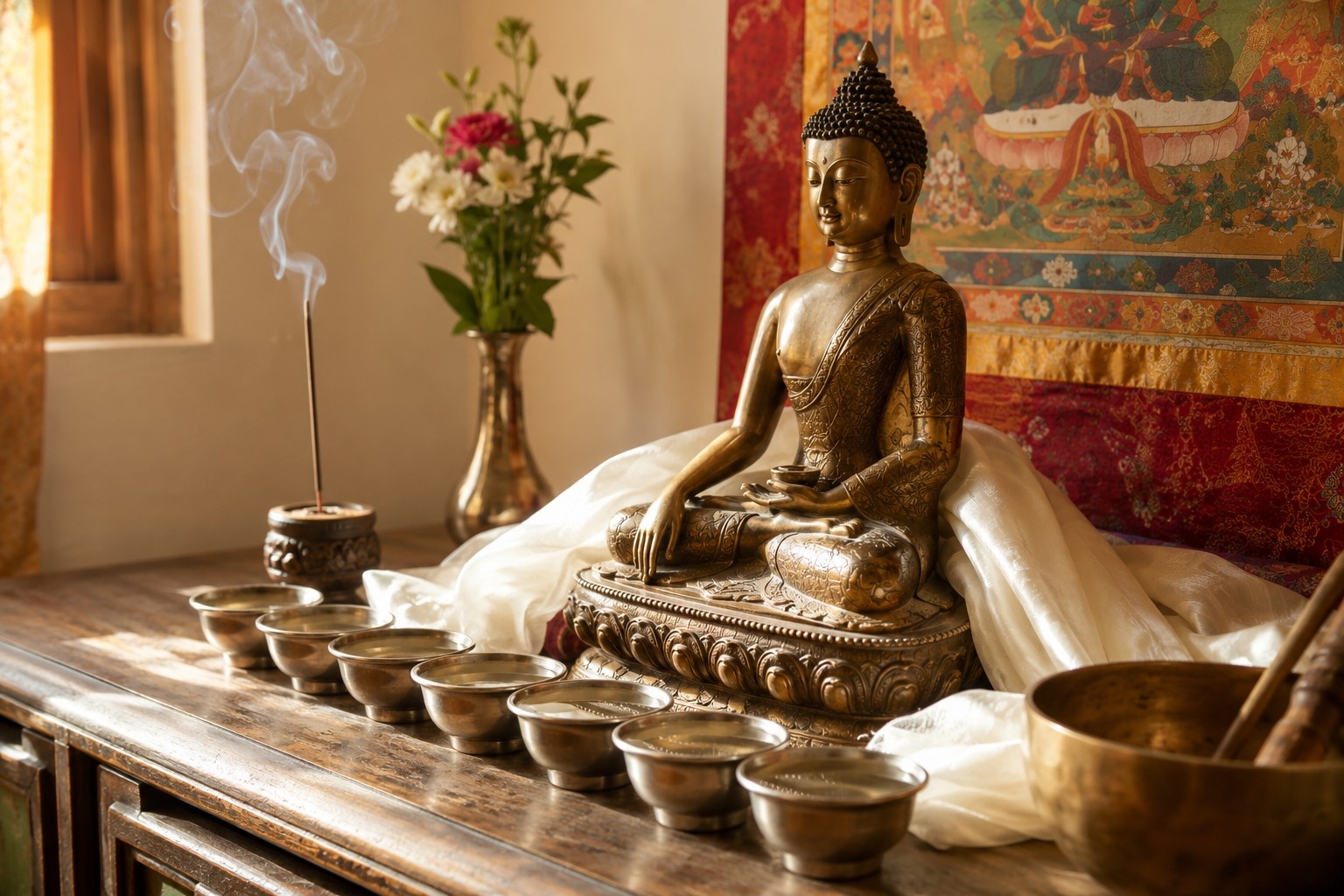
In Tibetan households, the Chokshom, the sacred home shrine, has been a natural part of daily life for centuries. It is a carefully prepared space for offerings and prayer, where representations of the Buddha, traditional offering bowls, incense and light come together to give life a spiritual centre. This article explains what makes a Tibetan home altar, which objects belong on it, and how to set one up and care for it with respect and attention.
A Space for What Matters
No temple is required. No community, no prior knowledge, no years of formal practice. In Tibetan, the sacred home shrine is called mChod gShom (མཆོད་གཤོམ།), pronounced Chokshom / Chöshom. The name comes from two words: mChod, meaning offering, and gShom, meaning to arrange or prepare. Together they describe exactly what this space is: a carefully prepared place for offerings, where representations of an enlightened Buddha's body, speech and mind are arranged alongside traditional gifts of devotion. The Chokshom is one of the most accessible and at the same time most profound expressions of Buddhist practice that exists.
In Tibetan homes, whether in the Himalayas or in the Tibetan diaspora around the world, a shrine like this is simply part of life. It is not a decorative element and not a status symbol. It is a daily point of contact with what is essential, a physical anchor for one's own spiritual practice, an invitation to pause in the middle of a busy life.
This article is for anyone drawn to the Tibetan Buddhist tradition who would like to bring such a place into their own home, approached with respect, care and an open heart.
The Meaning of the Home Altar in Tibetan Tradition
In Tibetan Buddhism, the boundary between the sacred and the everyday is fluid. Daily life itself is meant to be permeated by spiritual quality: every action, every encounter, every breath can be a moment of mindfulness and compassion. The home altar makes this understanding visible. It is a reminder that practice is not confined to the monastery or the meditation session but runs through the whole of life.
Traditionally, the home altar occupies the most important room in the house, usually the living room or a dedicated space. It is always placed in an elevated position, never on the floor, and never where one would turn one's back to it or stretch one's legs toward it. These gestures of respect are not merely outward convention. They express an inner attitude of reverence toward the qualities the altar represents: enlightenment, wisdom and compassion.
In a Western home, this spirit translates fully. A shelf, a small sideboard, a windowsill or a dedicated table can become an altar the moment one approaches it with awareness and care.
The Three Jewels as the Heart of the Altar
The foundation of every Tibetan Buddhist altar is the Three Jewels: the Buddha, the Dharma and the Sangha. They are the spiritual heart of the entire Buddhist tradition and find a visible, tangible form on the altar.
The Buddha is typically represented by a statue. The most common depiction is the historical Buddha Shakyamuni in the earth-touching gesture, the Bhumisparsha Mudra, in which the right hand reaches down to touch the ground as witness to his enlightenment. Representations of the Medicine Buddha, Buddha Amitabha or the bodhisattva Avalokiteshvara, the embodiment of compassion, are equally prevalent and deeply meaningful.
A statue of the Buddha or a bodhisattva on the altar is not an object of worship in a religious sense. It is a focal point, a mirror of the qualities to be cultivated in one's own practice. To sit before a Buddha statue in meditation is to direct one's attention toward awakening, toward the possibility of liberation that lies within every being.
The Dharma, the teaching of the Buddha, finds its place on the altar often in the form of a Dharma text, a small prayer scroll or a book of teachings. It represents the path, the orientation, the wisdom that flows from the teaching.
The Sangha, the community of practitioners, can be represented by a photograph of a revered teacher, if one has a teacher to whom one feels connected.
What Belongs on the Altar: The Seven Traditional Offerings
In Tibetan Buddhism, seven offerings are traditionally made on the altar. They are not an expression of magical practice but a daily exercise in generosity and devotion, a physical gesture of opening the heart.
The seven offerings in traditional sequence are: drinking water, washing water, flowers, incense, light, perfumed water and food. In everyday home altar practice, these are often simplified and adapted to what is available. What matters is not completeness but the quality of attention and the purity of motivation.
Offering bowls are the classic vessel for these gifts. Traditionally crafted from metal, often brass or copper, they are placed in a row of seven or more bowls side by side. The bowls are filled with fresh water each morning and emptied each evening, then stored upside down so no dust settles inside. This daily ritual of filling and emptying is itself a form of practice: conscious, regular, careful.
Incense is one of the most significant offerings of all. The rising fragrance symbolises the ascent of prayers, the purification of the surrounding environment and the mind, and the offering of respect to the Buddhas and bodhisattvas. Traditional Tibetan incense differs fundamentally from Indian or Japanese incense sticks: it is composed of dozens of natural ingredients including sandalwood, juniper, saffron, nutmeg and sacred herbs from the Himalayas. Each blend has its own quality and purpose. Riwo Sangchoe, for example, is an incense used specifically in the smoke-offering ritual of the same name and is considered particularly effective for invoking the blessings of the Buddhas and protector deities.
Light is traditionally represented by butter lamps. The flame symbolises wisdom dispelling the darkness of ignorance. In a Western household, candles or small tealight holders can serve this purpose equally well, provided they are lit with awareness.
Flowers represent the transient beauty of the phenomenal world and at the same time serve as a reminder of the impermanence of all things. Fresh flowers on the altar are replaced regularly as soon as they begin to wilt, as faded offerings are considered inappropriate.
The Statue: Centrepiece and Point of Orientation
Among all the elements of the home altar, the statue holds a special position. It is the first thing the eye seeks on entering the room, and the last thing one thinks of when leaving. The choice of statue is therefore a deeply personal decision, guided by one's own practice, spiritual affinities and the counsel of a teacher if one is available.
Handcrafted statues from Nepal, made using the traditional lost-wax casting technique, carry a quality of craftsmanship and devotion that mass-produced objects simply do not possess. Each such statue is unique, shaped by the hands and intention of the artisan who made it. To place such a statue on one's altar is to take one's place in a tradition that stretches back thousands of years.
Before a new statue is placed on the altar, it is traditionally consecrated in the Tibetan tradition, meaning blessed by a qualified lama or monk and activated through prayer. This consecration is considered essential, as it transforms the statue from a crafted object into a spiritual representation of the relevant deity or Buddha. Those who do not have access to a lama can place the statue on the altar to begin with and arrange for a blessing later.
The Khata: A Sign of Respect and Pure Intention
A khata, the white silk scarf of Tibetan tradition, belongs on every home altar. It is wrapped around the base of a statue or draped before it as a sign of reverence, pure intention and connection with the depicted deity or Buddha.
White represents purity, transparency and the unstained nature of the mind in Tibetan symbolism. Whenever a khata is offered, whether to a person, a teacher or a sacred representation, the giver expresses: I come with an open heart, without hidden agenda, in sincere connection.
Renewing the khata on the altar from time to time, particularly on special occasions or after a period of intensive practice, is a quiet but meaningful gesture.
Singing Bowls and Other Meditation Objects
Many home altar practitioners place a singing bowl on or near their shrine. It is struck at the beginning and end of a meditation session, its sound marking the transition from everyday life into stillness and back again.
In Tibetan Buddhism, the sound of the bowl is more than an acoustic signal. It is itself a form of mantra, a sound that gathers the mind and clears the space. The quality of the singing bowl, its material, its form and the manner in which it was made, influences its sound and therefore its meditative effect.
A prayer bead string, a mala, also often finds its place at the edge of the altar when not held in the hands. It is not a piece of jewellery to be set aside but a practice tool kept close to the altar space, strengthening the connection between the physical place of practice and the instrument of practice.
Setting Up the Altar: Practical Guidance
The most important rule when setting up a home altar is this: there is no absolute rule. What matters is one's own sincerity, care and the spirit in which the altar is arranged and maintained. That said, there are a few guiding principles from the Tibetan tradition that can serve as orientation.
The altar should be in a clean, quiet place, ideally in a room where one also meditates or prays. It should be positioned higher than one's own seated position during prayer or meditation, so that one looks up toward it. It should never be in a bathroom or next to a toilet, nor in a bedroom where sexual activity regularly takes place, as this is considered disrespectful toward the beings represented.
The arrangement of objects on the altar follows a traditional logic: the Buddha statue stands at the centre or highest point. To its left, a Dharma text or image of a teacher. To its right, a singing bowl or other ritual objects. The offering bowls stand in a row in front of the main objects. Incense and light flank the arrangement on either side.
The size of the altar is irrelevant. A single shelf holding a small statue, an incense holder and one offering bowl can be just as meaningful as a large, richly appointed shrine, provided it is tended with attention.
Daily Care: Rituals That Transform
The home altar reveals its full depth only through daily care. It is not the act of setting it up that brings it to life but the recurring ritual of attention that gradually transforms it into a genuine spiritual centre of the home.
A simple daily practice might look like this: in the morning, before stepping into the day, one approaches the altar, bows or folds the hands, lights an incense stick or a candle, fills the offering bowls with fresh water and recites a short prayer or mantra. In the evening, one empties the water bowls, extinguishes the light and withdraws in silence.
This ritual need not be long. Three minutes in the morning and two in the evening are entirely sufficient to give the day a spiritual frame. What changes over time is the quality of attention one brings to this moment. The bow becomes deeper. The lighting of the incense more conscious. The brief pause before the altar becomes a moment one genuinely looks forward to.
Avalokiteshvara on the Altar: The Bodhisattva of Compassion
One of the figures most frequently found on home altars alongside the Buddha Shakyamuni is Avalokiteshvara, known in Tibetan as Chenrezig, the bodhisattva of compassion. His depiction, usually with four or a thousand arms each bearing a different gift, symbolises the boundless readiness of compassion to help all sentient beings.
The mantra Om Mani Padme Hum is the mantra of Avalokiteshvara and the most widely recited mantra in Tibetan Buddhism. It finds its natural home in daily practice at the altar: a mala in hand, a few minutes of quiet recitation before an image or statue of Chenrezig is one of the simplest and yet most effective forms of Buddhist practice available to anyone.
What the Altar Really Means
In the end, the home altar is nothing more and nothing less than an invitation. An invitation to pause each day. An invitation to remember what truly matters: compassion, wisdom, gratitude. An invitation to lift the mind out of the current of daily thoughts and allow it to rest, even briefly.
In the Tibetan tradition it is said that a place where prayer and meditation are practised regularly develops its own quality of stillness over time. The walls absorb the prayers. The space becomes familiar, warm and welcoming. Those who spend even a few minutes each day at their altar will find that the place calls to them before they have thought of going there themselves.
That may be the greatest gift a home altar can offer: not another obligation in an already full life, but a place one genuinely wants to go.
A Closing Reflection: Begin Small, Grow Deep
Anyone wishing to set up a home altar does not need to get everything right immediately. It is enough to begin with a single object: a statue that speaks to you, an incense holder, a small bowl filled with fresh water. The rest grows with the practice.
What matters from the very beginning, however, is the attitude: care, respect and the sincere intention to create a place that serves not the eye but the mind. Such a place, even if it consists of only three objects on a shelf, carries within it the full depth of a tradition thousands of years old.
Comments
Be the first to comment...